
Deputies of the City Duma and the Legislative Assembly — the people who make decisions about the city and the region: biographies, convocations, committees and votes. The section covers deputies of the Regional Legislative Assembly of the VII convocation (2021–2026), with their factions and places in the influence rating, and deputies of the Nizhny Novgorod City Duma by electoral district.
The remit of the two bodies is set out by law and hardly overlaps. Under the 2025 Charter, the City Duma consists of 39 deputies elected for five years exclusively in single-mandate districts, and its exclusive competence covers adoption of the city Charter, approval of the budget and of the report on its execution, the introduction and abolition of local taxes and levies, the strategy of social and economic development, and the procedure for disposing of municipal property; the head of the city is elected by the Duma itself from candidates put forward by the governor, likewise for five years. The Legislative Assembly passes the laws of the region and its budget, appoints justices of the peace, and has established regional institutions — the Commissioner for Human Rights (III convocation, with Vasily Olnev the first appointee), then the commissioners for children's rights and for the protection of entrepreneurs' rights, and the chamber of control and accounts — and it was on its initiative that the Day of Glory of the Nizhny Novgorod Militia was established, out of which grew the Day of National Unity celebrated since 2005; among the laws of the VI convocation the deputies themselves count as the most notable the law on the organisation of regular transport services (2017, No.
11-Z), on the development of agriculture (2018, No. 74-Z), on measures of support for large families in lieu of a land plot (2020, No. 26-Z), on assistance to defrauded shared-construction investors (2020, No. 63-Z) and on social entrepreneurship (2020, No. 165-Z). Over thirty years the picture of factions travelled from the non-partisan dumas and assemblies of the 1990s — in the 1994 elections there were no party lists at all — to two factions in the IV convocation of the Legislative Assembly, four in the V convocation and five in the VII. The present City Duma has four deputy associations: United Russia (28 deputies, led by Yevgeny Kostin), the CPRF (5, Nikolai Sataev), the LDPR (3, Irina Molkova) and A Just Russia — For Truth (2, Alexey Kozhukhov); the chairman of the Duma is Yevgeny Alexandrovich Chintsov, elected in district No. 30, the first deputy chairman is Yevgeny Kostin, and the deputy chairman is Kirill Lazorin. [1]
Regional Legislative Assembly
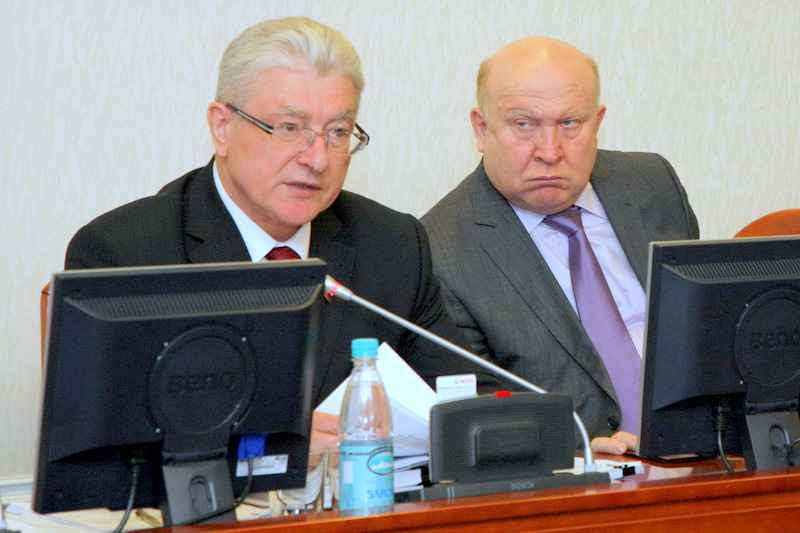
The regional parliament grew out of the last Soviet convocation. The Regional Council of People's Deputies of the 1990 convocation numbered 255 deputies, met in the "round" hall of the House of Soviets and was headed in turn by Gennady Khodyrev, Alexander Sokolov and Yevgeny Krestyaninov; by its decisions the city of Gorky had the name Nizhny Novgorod restored to it, the region was opened to foreigners, and Boris Nemtsov's candidacy was recommended to the president for the post of governor. After 1991 the Council formed out of itself a Small Council of 37 members, on 21 October 1993 adopted the "Basic Principles of the Statute on the Legislative Assembly" and called elections for March 1994.
The Legislative Assembly of the I convocation was formed for just two years and consisted of 45 single-mandate deputies, a considerable part of whom were heads of city and district administrations; Anatoly Kozeradsky became chairman, with Alexander Listkov and Sergey Makov as his deputies, 8 deputies worked on a permanent basis, 10 committees and commissions operated, and the main task was the adoption of the region's Charter. In the II convocation (also 45 deputies) Kozeradsky was replaced in November 2001 by Dmitry Bednyakov; the III convocation, elected in March 2002, was headed by Yevgeny Lyulin, who also introduced into the Charter the provision on the future composition — 50 deputies, of whom 25 are elected in single-mandate districts and 25 from party lists; this mixed system came into operation with the 2006 elections.
The IV convocation (2006–2011) was led after May 2007 by Viktor Lunin, and the V convocation, elected in March 2011, and the VI convocation by Yevgeny Lebedev. In the elections to the VI convocation in September 2016, with a turnout of 43.95 percent, United Russia won 41 seats, the CPRF 4, the LDPR 3, and A Just Russia 2; the first session was twice disrupted for lack of a quorum and took place only on 11 October 2016, and in October 2020 Yevgeny Lyulin again became speaker. The deputies of the VII convocation, elected in September 2021, convened on 5 October 2021 and formed five factions: United Russia — 40 deputies, the CPRF — 5, the LDPR — 2, A Just Russia — For Truth — 2, New People — 1. [2]
| Name | Convocation and district | Description |
|---|---|---|
| Lyulin | VII convocation (2021–2026) | Chairman of the Legislative Assembly of Nizhny Novgorod Oblast. Faction: United Russia — United Russia |
| Sukhanov Vasily Ivanovich | VII convocation (2021–2026) | Chairman of the Legislative Assembly committee on urban development, property and land relations. Faction: United Russia — United Russia |
| Igor Alexandrovich Tyurin | VII convocation (2021–2026) | General director of JSC Karavai. Chairman of the Legislative Assembly committee on the agro-industrial complex and rural development. Faction: United Russia — United Russia |
| Sharonov Alexander Georgievich | VII convocation (2021–2026) | Chairman of the board of PJSC NBD-Bank, chairman of the Legislative Assembly committee on the budget and taxes. Faction: United Russia — United Russia |
| Atmakhov Vladislav Olegovich | VII convocation (2021–2026) | Chairman of the Legislative Assembly committee on ecology and nature management. Head of the LDPR faction in the Legislative Assembly — LDPR |
| Bakiev Denis Ildusovich | VII convocation (2021–2026) | Deputy chairman. Faction: United Russia — United Russia |
| Dosaev Rustam Abdulkaderovich | VII convocation (2021–2026) | Head of the faction of the New People political party in the Legislative Assembly — New People |
| Antonov Alexey Anatolyevich | VII convocation (2021–2026) | Deputy chairman, head of the United Russia faction in the Legislative Assembly — United Russia |
| Balashov Yuri Pavlovich | VII convocation (2021–2026) | General director of LLC Sadko Dentistry Development Centre. Faction: United Russia — United Russia |
| Tabachnikov Alexander Feliksovich) | VII convocation (2021–2026) | Deputy director for capital construction at JSC Atomenergoprom. Faction: United Russia — United Russia |
| Grinevich Tatyana Borisovna | VII convocation (2021–2026) | Head of the staff of the regional branch of the socialist political party A Just Russia in Nizhny Novgorod Oblast. Head of the party's faction in the Legislative Assembly — A Just Russia |
| Smotrakova Natalya Borisovna | VII convocation (2021–2026) | Chairwoman of the committee on social affairs. Faction: United Russia — United Russia |
| Nikolai Yevgenyevich Upirvitsky | VII convocation (2021–2026) | Deputy chairman of the Legislative Assembly committee on the economy, industry, support for entrepreneurship, trade and tourism. Faction: United Russia — United Russia |
| Bespalov Vladimir Viktorovich | VII convocation (2021–2026) | Chairman of the committee on housing and utilities and the fuel and energy complex. Faction: United Russia — United Russia |
| Igor Norenkov | VII convocation (2021–2026) | Chairman of the Legislative Assembly committee on the economy, industry, support for entrepreneurship, trade and tourism. Faction: United Russia — United Russia |
| Antipov Valery Alexandrovich | VII convocation (2021–2026) | General director of LLC Firma AKA. Faction: United Russia — United Russia |
| Krasnov Dmitry Germanovich | VII convocation (2021–2026) | Deputy chairman of the Legislative Assembly of Nizhny Novgorod Oblast. Faction: United Russia (until February 2026). United Russia |
| Garevskaya Yulia Anatolyevna | VII convocation (2021–2026) | Chief physician, obstetrician-gynaecologist at City Clinical Hospital No. 29. Faction: United Russia (from April 2026). United Russia |
| Soldatenkov Vladimir Ivanovich | VII convocation (2021–2026) | Chairman of the Legislative Assembly committee on transport and roads |
| Lebedev Yury Isakovich | VII convocation (2021–2026) | General director of LLC Istoriya-NN. Faction: United Russia — United Russia |
| Burkova Lyudmila Nikolaevna | VII convocation (2021–2026) | Deputy chairwoman. Deputy general director of the Diagnostic Systems research and production association. Faction: KPRF — KPRF |
| Tarasov Andrey Nikolaevich | VII convocation (2021–2026) | Deputy chairman of the Legislative Assembly committee on urban development, property and land relations. Faction: United Russia (until July 2026) — United Russia |
| Kabeshev Roman Vladimirovich | VII convocation (2021–2026) | Head of the KPRF faction. Deputy chairman of the Legislative Assembly committee on ecology and nature management. KPRF |
| Greben Anton Alexandrovich | VII convocation (2021–2026) | Deputy general director for public relations — head of the centre at LLC LUKOIL-Nizhegorodnefteorgsintez. Faction: United Russia — United Russia |
| Babaev Yevgeny Alexandrovich | VII convocation (2021–2026) | President of JSC ITECO. Faction: United Russia — United Russia |
| Igor Leonidovich Gordeyev) | VII convocation (2021–2026) | General director of LLC Grand-NN. Faction: United Russia — United Russia |
| Pakov Vladimir Nikolaevich | VII convocation (2021–2026) | Chairman of the Legislative Assembly committee on state authority, local self-government and rules of procedure. Faction: United Russia — United Russia |
| Aksinin Vyacheslav Borisovich | VII convocation (2021–2026) | General director of LLC ZEFS-ENERGO. Faction: United Russia — United Russia |
| Kiritsa Oleg Sergeyevich | VII convocation (2021–2026) | Deputy chairman of the committee on state authority of the region, local self-government and rules of procedure. Faction: KPRF — KPRF |
| Timofeev Alexander Alimpievich | VII convocation (2021–2026) | Director of the Sustainable Development of Nizhny Novgorod Oblast foundation. Faction: United Russia — United Russia |
| Apoyan Solomon Haykazovich | VII convocation (2021–2026) | Chief physician of the Nizhny Novgorod Regional AIDS Centre, Faction: United Russia — United Russia |
| Bednyakov Dmitry Ivanovich | VII convocation (2021–2026) | Adviser-mentor to the governor of Nizhny Novgorod Oblast. Faction: United Russia — United Russia |
| Barykov Alexander Mikhailovich) | VII convocation (2021–2026) | Managing director of JSC OMK, Faction: United Russia — United Russia |
| Rebrov Maksim Evgenyevich | VII convocation (2021–2026) | Head of the staff of the Legislative Assembly of Nizhny Novgorod Oblast. Faction: United Russia — United Russia |
| Ananyin Anton Alexandrovich) | VII convocation (2021–2026) | General director of LLC Volgaspetsstroy. Faction: LDPR — LDPR |
| Tsopov Alexander Vladimirovich | VII convocation (2021–2026) | Deputy chairman of the committee on social affairs. Faction: United Russia — United Russia |
| Malukhin Dmitry Alexandrovich | VII convocation (2021–2026) | General director of LLC Mayak. Faction: United Russia — United Russia |
| Chernigin Alexander Grigoryevich | VII convocation (2021–2026) | Faction: KPRF — KPRF |
| Pershin Mikhail Nikolaevich | VII convocation (2021–2026) | Faction: United Russia — United Russia |
| Zudilin Yevgeny Ivanovich) | VII convocation (2021–2026) | General director of LLC RUMOEnergo. Faction: KPRF — KPRF |
| Yakimov Yuri Minovich | VII convocation (2021–2026) | Deputy director of the federal state unitary enterprise RFNC-VNIIEF. Faction: United Russia — United Russia |
| Frolov Alexei Andreyevich | VII convocation (2021–2026) | Faction: A Just Russia. A Just Russia |
| Boryakin Sergey Viktorovich | VII convocation (2021–2026) | Sole proprietor. Faction: United Russia — United Russia |
| Stepanov Alexei Vladimirovich | VII convocation (2021–2026) | General director of JSC Ilyino-Zaborskoye. Faction: United Russia — United Russia |
| Makarova Irina Anatolyevna | VII convocation (2021–2026) | Head of outpatient clinic No. 2 of Clinical Hospital No. 50 of the Federal Medical and Biological Agency. Faction: United Russia — United Russia |
| Pichugin Vadim Vladimirovich | VII convocation (2021–2026) | LLC Specialised Developer Terminal SK, Faction: United Russia — United Russia |
| Ruzankin Igor Evgenyevich | VII convocation (2021–2026) | Sole proprietor. Faction: United Russia (until July 2026). United Russia |
| Melin Andrey Viktorovich | VII convocation (2021–2026) | Faction: United Russia (until March 2026). United Russia |
| Kolyvanov Dmitry Evgenyevich | VII convocation (2021–2026) | Faction: United Russia (until February 2026). United Russia |
| Paramonov Alexander Vasilyevich | VII convocation (2021–2026) | Faction: United Russia (until April 2026). United Russia |
The City Duma of Nizhny Novgorod
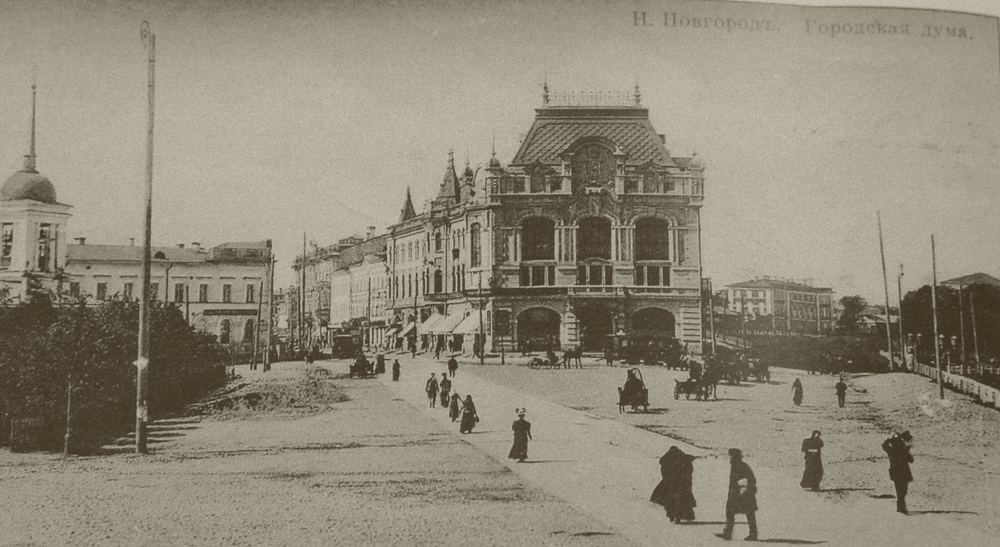
Municipal representation in Nizhny Novgorod is almost a century older than the urban reform of Alexander II. The right of the "town society" to elect a general duma and a six-member duma was granted by the Charter to the Towns of 1785, and on 5 July 1787 the Nizhny Novgorod General City Duma assembled for the first time; its sittings were chaired by the town head Ivan Alekseevich Bryzgalov. The first councillors were the merchants Yakov Shchepetilnikov and Ivan Syreyshchikov, the townsmen Ivan Nishchenkov, Nikita Khvastunov and Semyon Vetoshnikov, the guild craftsmen Stepan Zaikin, Andrey Kolchin, Stepan Rybanov, Sergey Smirnov and Semyon Serebrennikov, and, from the "genuine town residents", the merchant Vasily Kosarev and two officers of noble birth who never turned up at the sittings.
On 6 July 1787 the executive six-member duma was elected from the membership of the general duma (Kosarev, Nishchenkov, Smirnov, Shchepetilnikov), and as early as 8 July, at its first sitting in the House of the Town Society on Nizhny Bazar, the councillors demanded from the town magistracy information on municipal revenues and on quit-rent items — mills, fisheries, ferries — and resolved to fix a market day and a market place in the town. At the same time they started the attendance journals and commissioned a town seal with the coat of arms; for the illiterate councillor Nishchenkov, "his seal is affixed" in the journal. [3]
The duma acquired its modern shape under the Municipal Statute of 16 June 1870, which gave municipal self-government the right to tax real estate, trading and industrial establishments, and merchant and trade licences, and to dispose of that money. Only taxpayers became voters, divided into three categories in such a way that each category paid one third of the municipal levies: in Nizhny Novgorod in 1870 the first category included 64 people, the second 224, the third 2,116, and each category elected 24 councillors, 72 in all. The list of 2,404 voters was submitted by the town head A. M. Gubin to Governor A. A. Odintsov on 5 October, the governor approved it on 25 November, and on 21 December 1870, after the liturgy in the Saviour Transfiguration Cathedral of the kremlin, the electoral assembly of the first category opened; turnout was 50 per cent among the largest taxpayers, 21 among the middling ones and 5 among the small ones.
The new duma comprised 50 merchants and honorary citizens, 12 burghers and guild craftsmen, and 10 noblemen — among them the brewer D. N. Babushkin, the former town heads I. S. Kvartalov and V. K. Michurin, the future town head V. A. Sobolev, the provincial marshal of the nobility M. B. Prutchenko, and the petroleum chemist and engineer V. I. Ragozin. On 30 December 1870 the councillors took the oath, again elected A. M. Gubin as town head and formed the town council; the duma and the council were housed in the Municipal Public House on Blagoveshchenskaya Square (now Minin and Pozharsky Square). [4]
The Duma's powers covered street improvement and lighting, pavements, gardens, bridges and drainage pipes, markets, public health, education, fire safety and public poor relief; its binding ordinances had to be agreed with the police chief and the governor, while contested cases went to the Provincial Board for Municipal Affairs. The practical measure of these powers is known from specific decisions: a commission on building the second water supply system (1871), the opening of the city's first maternity institution (6 January 1874, today Maternity Hospital No. 1), the resolution of 1 December 1875 "to have a Realschule in Nizhny Novgorod", and, in 1878, the refusal of a 450,000-rouble loan for the water supply after the Blinovs, the Bugrovs and the merchant U. S. Kurbatov donated 250,000 roubles on the condition that water from the new system be "free for all time" to people of every social estate.
The Municipal Statute of 1892 replaced the tax qualification with a high property qualification: only owners of real estate worth no less than 1,000, and later 1,500, roubles remained voters, and in a city of a hundred thousand they amounted to about fifteen hundred. The mayors after Gubin were D. N. Delvig (elected 13 April 1893, 47 votes to 8), A. M. Memorsky (from 1897, and then twice more) and the steamship owner D. V. Sirotkin, who won on 27 March 1913 with 45 white balls against 28. Under Delvig the Duma granted 44 dessiatinas of pasture land free of charge for the 16th All-Russian Industrial and Art Exhibition of 1896; under Sirotkin, in 1913, it floated a bond loan of 2 million roubles for sewerage (a collector on Kovalikha, a treatment plant and a 600-metre tunnel under Sennaya Square, 1914–1915), on 15 October 1914 signed the buy-out of the tram and electricity enterprise from the Russian Society of Electric Railways and Electric Lighting, in 1915 concluded a contract for a permanent bridge across the Oka, and on 18 January 1916 opened the People's University, out of which the present-day NNGU grew. [5]
In 1917 the Duma tried to fit itself into the revolution and failed to hold on. On 1 March it endorsed the City Public Committee, on 10 April it "self-democratised", adding ten councillors from each of the city's four parts, and on 16 July 1917 elections by party lists were held for the first time: the Socialist Revolutionaries won with 39 per cent, and on 1 August Vladimir Genrikhovich Ganchel, a soldier of the 185th Reserve Infantry Regiment, was elected city mayor. On 26 October the Duma called the Bolshevik coup a crime and set up a Committee for the Defence of the Revolution; on 21 December Ganchel and the municipal board resigned their powers, and on 5 January 1918 the executive committee of the Nizhny Novgorod Soviet of Workers' and Soldiers' Deputies resolved to dissolve the Duma and hand city government over to the Soviet "until new elections" — which took place only in 1994.
A separate Nizhny Novgorod City Soviet of Workers' and Red Army Deputies, made up of 196 people elected from factories and military units, met for the first time on 6 October 1918; its first chairman was Nikolai Grigoryevich Kozitsky, a deputy from the workers of the Siemens and Halske plant. Elections to the Soviets were not universal (in 1928 some 7,436 people in Nizhny Novgorod were deprived of electoral rights) and were held by open voting at meetings organised by enterprises and trade unions. On 9 January 1928 the All-Russian Central Executive Committee merged Nizhny Novgorod, Kanavino and Sormovo into a single city; in 1930 the first elections to the unified city soviet were held — 511 deputies; the Constitution of 1936 restored the secret ballot, while the city soviet's policy was largely determined by the party city committee created in 1932. The system of Soviets was abolished in 1993 during the political crisis. [6]
The present-day City Duma of Nizhny Novgorod was elected on 27 March 1994 and held its first session on 11 April 1994: it was attended by 25 deputies whose constituencies had passed the 25 per cent turnout threshold — at that session credentials were handed out, Ivan Karnilin was elected chairman and Alexander Maltsev his deputy, and in the autumn of the same year by-elections brought the membership up to 34 deputies, one per constituency across the city's eight districts. The Duma of the first convocation (1994–1996) adopted the first city budget and the first City Charter, under which the first direct popular elections of the head of the city were held — won by Ivan Sklyarov — and launched territorial public self-government: in 1994 the first 18 TOS councils appeared.
After that the membership grew and changed in the way it was elected: the 3rd convocation (2000–2005) — 34 deputies, the 5th convocation (2010–2015) — 42 (28 single-mandate members and 14 from party lists: 9 seats for United Russia, 2 each for A Just Russia and the CPRF, 1 for the LDPR), the 6th convocation (2015–2020) — 47 (35 constituencies plus 12 list seats), the 7th convocation (2020–2025) — 35 deputies, already without a party list. On 4 April 2025, by Nizhny Novgorod Region law No. 45-Z, the urban okrug of the city of Nizhny Novgorod and the Kstovo municipal okrug were merged into a newly formed urban okrug, so the count of convocations started afresh: at the elections of 12–14 September 2025, 39 seats were contested, 28 of them going to United Russia, and on 12 November 2025, by decision No. 67, the Duma approved a new City Charter. [7]
| Name | Convocation and district | Description |
|---|---|---|
| Vladimir Eduardovich Tarasov | VII convocation, district No. 1 | |
| Kirill Borisovich Lazorin | VII convocation, district No. 2 | |
| Roman Gennadiyevich Ponomarenko | VII convocation, district No. 3 | |
| Valery Valeryevich Skakodub | VII convocation, district No. 4 | |
| Anoshkin Vladimir Petrovich | VII convocation, district No. 5 | |
| Maria Vladimirovna Kuznetsova | VII convocation, district No. 6 | |
| Vladimir Valeryevich Amelchenko | VII convocation, district No. 7 | |
| Karim Radikovich Ibragimov | VII convocation, district No. 8 | |
| Tatyana Aleksandrovna Druzhinina | VII convocation, district No. 9 | |
| Oksana Vasilyevna Smolina | VII convocation, district No. 10 | |
| Denis Yevgenyevich Mironov | VII convocation, district No. 11 | |
| Mikhail Ivanovich Rykhtik | VII convocation, district No. 12 | |
| Nikolay Petrovich Sataev | VII convocation, district No. 13 | |
| Maria Aleksandrovna Samodelkina | VII convocation, district No. 14 | |
| Ruslan Marsovich Stanchev | VII convocation, district No. 15 | |
| Inna Vyacheslavovna Vankina | VII convocation, district No. 16 | |
| German Yevgenyevich Karachevsky | VII convocation, district No. 17 | |
| Stanislav Stanislavovich Prokopovich | VII convocation, district No. 18 | |
| Yury Anatolyevich Yerofeev | VII convocation, district No. 19 | |
| Yulia Mikhaylovna Manturova | VII convocation, district No. 20 | |
| Pavel Dmitriyevich Pashinin | VII convocation, district No. 21 | |
| Mikhail Sergeyevich Ivanov | VII convocation, district No. 22 | |
| Sergey Sergeyevich Plyaskin | VII convocation, district No. 23 | |
| Yevgeny Nikolayevich Kostin | VII convocation, district No. 24 | |
| Zhanna Aleksandrovna Skvortsova | VII convocation, district No. 25 | |
| Elena Valeryevna Arzhanova | VII convocation, district No. 26 | |
| Oksana Vladimirovna Dektereva | VII convocation, district No. 27 | |
| Olga Valeriyevna Balakina | VII convocation, district No. 28 | |
| Anna Vyacheslavovna Kruglova | VII convocation, district No. 29 | |
| Yevgeny Aleksandrovich Chintsov | VII convocation, district No. 30 | |
| Aleksey Alekseyevich Kozhukhov | VII convocation, district No. 31 | |
| Mark Samuilovich Feldman | VII convocation, district No. 32 | |
| Nikolay Aleksandrovich Chernyshov | VII convocation, district No. 33 | |
| Vladimir Valeryevich Poddymnikov-Gordeyev | VII convocation, district No. 34 | |
| Anna Valeryevna Tatarintseva | VII convocation, district No. 35 |
Sources
- gordumannov.ru — Nizhny Novgorod City Duma — Deputies of the City Duma of the VI convocation (2015 — 2020) (archive)
- gordumannov.ru — Nizhny Novgorod City Duma — Deputies of the City Duma of the V convocation (2010 — 2015): single-mandate districts and the municipal electoral district (archive)
- opentextnn.ru — Открытый текст — F. A. Seleznyov. The birth and first steps of the Nizhny Novgorod City Duma (late 18th — first half of the 19th century): the convocation of 1787 — 1788 (archive)
- gordumannov.ru — Nizhny Novgorod City Duma — F. A. Seleznyov. Essays on the history of the City Duma. Chapter 2. The Duma firmly finds its feet (1870 — 1892) (archive)
- gordumannov.ru — Nizhny Novgorod City Duma — F. A. Seleznyov. Essays on the history of the City Duma. Chapter 3. The time of flourishing (1893 — 1917) (archive)
- gordumannov.ru — Nizhny Novgorod City Duma — F. A. Seleznyov. Essays on the history of the City Duma. Chapter 4. The Soviet era (archive)
- gordumannov.ru — Nizhny Novgorod City Duma — The first session of the Nizhny Novgorod City Duma took place 25 years ago (11 April 2019) (archive)
- gordumannov.ru — Nizhny Novgorod City Duma — List of deputies of the City Duma of the VII convocation, single-mandate electoral districts 2020 (archive)
- gordumannov.ru — Nizhny Novgorod City Duma — Charter of the municipal formation of the urban district of the city of Nizhny Novgorod, approved by decision of the City Duma of 12 November 2025 No. 67 (archive)
- gordumannov.ru — Nizhny Novgorod City Duma — Deputy associations in the City Duma of the city of Nizhny Novgorod (archive)
- gordumannov.ru — Nizhny Novgorod City Duma — On the chairman of the City Duma of the city of Nizhny Novgorod (E. A. Chintsov) (archive)
- gordumannov.ru — Nizhny Novgorod City Duma — 10 years. 1994 — 2004 (anniversary edition, PDF) (archive)
- Нижегородская правда — United Russia won 28 seats in the Nizhny Novgorod City Duma (16 September 2025) (archive)
- Нижегородская правда — The parliament has been renewed: what the deputies of the Legislative Assembly will take on (28 September 2021, the first session of the VII convocation — 5 October) (archive)
- web.archive.org — Legislative Assembly of Nizhny Novgorod Oblast, zsno.ru (web archive) — Museum of the History of Representative and Legislative Power: Regional Council of People's Deputies of the 1990 convocation (archive)
- web.archive.org — Legislative Assembly of Nizhny Novgorod Oblast, zsno.ru (web archive) — Museum of the History of Representative and Legislative Power: Legislative Assembly of the I convocation (archive)
- web.archive.org — Legislative Assembly of Nizhny Novgorod Oblast, zsno.ru (web archive) — Museum of the History of Representative and Legislative Power: Legislative Assembly of the III convocation (archive)
- web.archive.org — Legislative Assembly of Nizhny Novgorod Oblast, zsno.ru (web archive) — Museum of the History of Representative and Legislative Power: Legislative Assembly of the VI convocation (election results… (archive)
- web.archive.org — Legislative Assembly of Nizhny Novgorod Oblast, zsno.ru (web archive) — Gallery of the chairmen of the Regional Council of People's Deputies and the Legislative Assembly (archive)
- web.archive.org — Legislative Assembly of Nizhny Novgorod Oblast, zsno.ru (web archive) — Factions in the Legislative Assembly of the VII convocation: United Russia, CPRF, LDPR, SRZP, New People (size… (archive)