
From the Strelka to the Fair is a historic part of the city on the left bank of the Oka, right at the spit where the rivers meet: what grew up around the Makaryev Fair, moved here in 1817, and the merchant Nizhny Posad beneath the kremlin. The material is laid out by era: the tsarist period — the fair and merchant estates; the Soviet period — the river port, bridges and warehouses on the site of the trading grounds; our own time — the stadium, the pakgauz concert hall, and the new embankment. An object that has lived through several eras is placed under the one to which its heyday belongs.
The territory on the left bank of the Oka, at its confluence with the Volga, entered the country's history suddenly and through someone else's misfortune. The fair that gave it its shape was not born here: the trade grew up by the Makaryev Yellow-Waters Monastery, restored in 1624, and was officially established by Tsar Alexei Mikhailovich in 1648, when the first five days of trading were duty-free and payment was collected thereafter; in 1755 Elizabeth Petrovna made the fair state property, directing the revenue to the treasury rather than the monastery. The fire of 1816 destroyed the Makaryev tents and stalls, and in 1817 the government moved the fair to Nizhny Novgorod — onto a low, flood-prone sandy spit facing the city. For Nizhny this was a turning point: the sands between the Oka and the Volga, which until then had served as landings and warehouses for the Nizhny bazaar, turned within a single decade into the empire's principal trading ground. [1][2]
The tsarist period: the fair and the merchant shore
Construction of the fair complex proceeded from 1817 to 1828 under the engineer Augustin de Betancourt, and it was not ordinary building work but an engineering operation: the site was raised with fill, ringed with a canal, and given a stone Gostiny Dvor with trading rows, opened in 1822, and the Transfiguration Cathedral, in whose construction Auguste de Montferrand had a hand. The bypass canal was not decoration but a system: it held back water, served as fire protection, and, by the fair's own description, gave Russia its first European-style sewer system — underground galleries ran beneath the trading rows. The scale of the construction is visible in the archival trail as well: the Central Archive of Nizhny Novgorod Region holds fond 2362, the "Commission for the Audit of Reports of the Committee for the Construction of the Nizhny Novgorod Fair Gostiny Dvor," for 1828–1829. By 1890 the deteriorating Main House was replaced with a new one, in the neo-Russian style, designed by the architects Karl Treiman and Alexander von Hohen — the building that remains the face of the fair to this day. [2][3]
The fair earned its nickname "Russia's pocket" on the merits. Tea, metal, fish and furs converged here; here the merchant dynasties of the Bugrovs and the Rukavishnikovs rose; here prices were set that the whole of domestic trade then lived by. The opening of the Moscow–Nizhny Novgorod railway in 1862 multiplied the flow of people and goods, and by 1896 — the year of the 16th All-Russia Industrial and Art Exhibition and of Nicholas II's visit — the fairground stretched from the Moscow railway station to the Alexander Nevsky Cathedral on the Strelka, greeting guests with triumphal arches. The fair operated for two months a year, but those two months set the city's annual rhythm. [2][4]
Tea, metal, fish and furs converged here; here the merchant dynasties of the Bugrovs and the Rukavishnikovs rose; here prices were set that the whole of domestic trade then lived by
Memoirs of A. F.[4]
The Strelka acquired its dominant landmark in the second half of the 19th century. In the summer of 1858 Governor N. M. Muravyov backed the merchants' wish to build a second Orthodox church at the fair; on 18–22 August of that year Alexander II visited Nizhny, and on 24 August the merchant assembly decided to dedicate the altars to Alexander Nevsky, Mary Magdalene, and Nicholas the Wonderworker. Official approval followed in September 1859, the site was surveyed on 14 October, in 1860 the provincial architect R. Ya. Kileveyn drew up a general plan for the fair that received the highest approval, and the cathedral itself was built in 1867–1881. The local historian A. I. Davydov, examining documents from the Central Archive of Nizhny Novgorod Region and the Russian State Historical Archive, refutes the entrenched story that the emperor himself pointed out the site for the church: Alexander II approved only the choice of heavenly patrons, while the site was determined by Kileveyn. [5]
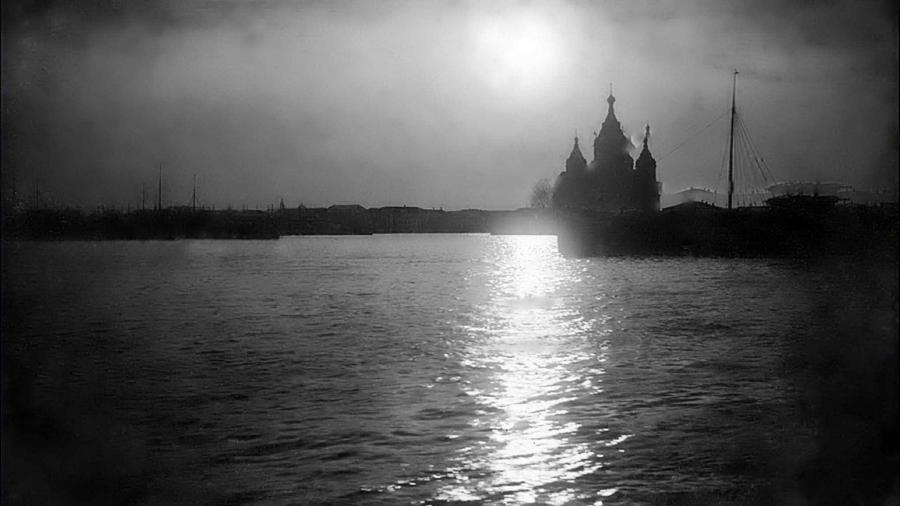
The fair did not live apart from the city: during trading season, Rozhdestvenskaya Street and the Oka embankment became part of one fairground organism. The division of Nizhny into the Upper and Lower Posad is known from the 13th century, and the 1824 general plan, approved by Betancourt and Guest, prescribed that Rozhdestvenskaya be built up in stone; in the 1830s–1840s new descents — the Pokhvalinsky, the Suyetinsky, the Zelensky — linked the street to the hill above. The provincial architect I. Ye. Yefimov developed for it a distinctive type of two-storey stone house with a mezzanine and a carriage passage to the courtyard — almost all of them have survived.
Here stand the Rozhdestvenskaya Stroganov Church of 1719, the house of the ironmonger I. S. Pyatov (No. 25), built by Betancourt in 1819, the estate of the Princes Golitsyn (No. 47) designed by D. I. Zhilyardi in 1837–1839, the Bugrov shelter for the homeless housing 700 people (No. 2), built in 1880–1885, and the bank of S. M. Rukavishnikov of 1908, the work of Fyodor Schechtel. By the early 20th century the street had become a business center: hotels, restaurants, exchanges, shipping-company offices, banks; in 1896 the city gained a kremlin funicular elevator and its first electric tram. [1]
| Name | Years | Description |
|---|---|---|
| Makaryev Fair | The predecessor of the Nizhny Novgorod fair: trade by the Makaryev Monastery, moved to Nizhny after the fire of 1816 | |
| Nizhny Novgorod Yarmarka | An all-Russia trading ground on the left bank of the Oka from 1817 — "Russia's pocket" | |
| Main Fair House | An 1890 building in the Russian style — the administrative heart of the fair | |
| Transfiguration Old Fair Cathedral (nnov.ec) | Auguste de Montferrand's 1822 cathedral — the fair's first church | |
| Aleksandra Nevskogo Cathedral | The New Fair Cathedral of 1881, right at the spit of the rivers | |
| The Bétancourt Canal | The engineer Betancourt's bypass canal, which ringed the fair's Gostiny Dvor | |
| All-Russian Industrial and Art Exhibition of 1896 | The empire's largest exhibition, laid out behind the fair | |
| Rozhdestvenskaya | The merchant street beneath the kremlin: banks, offices, shipping companies | |
| Rozhdestvenskaya (Stroganovskaya) Church) | Stroganov Baroque of 1719 — the main church of the Lower Posad | |
| Stroganov Estate on Rozhdestvenskaya) | The house of the salt magnates who gave the church and the style their name | |
| Rukavishnikov Bank Complex | The banking house of the family that held the iron trade | |
| Rukavishnikov Estate | A palace on Verkhnevolzhskaya — a showcase of merchant wealth | |
| Bugrov Income House with Volga-Kama Bank Branch) | The grain trader Bugrov's apartment house on Rozhdestvenskaya | |
| Bugrov Night Shelter) | A refuge for the homeless, described by Gorky in "The Lower Depths" | |
| Former Salt Office Building on Rozhdestvenskaya Street | The salt-tax farming office — a trace of the Lower Posad's chief commodity | |
| Church of Cosmas and Damian on Rozhdestvensky Street | A lost church of the Lower Posad's craftsmen | |
| Sirotkin Dmitry Vasilyevich | A steamship owner and city mayor who built on Verkhnevolzhskaya | |
| The Bugrovs | A dynasty of grain traders whose houses and shelters shaped the Lower Posad | |
| Rukavishnikovs | A merchant family whose buildings stand on Rozhdestvenskaya and the Volga | |
| Nizhny Posad | The part of the city beneath the kremlin, along the river | |
| Kanavino | The fair settlement that grew into a district across the river |
The Soviet period: the port, the bridges, the warehouses
After 1917 fair trade collapsed: in 1919–1920 the wooden buildings were dismantled for firewood. The New Economic Policy gave a brief reprieve — the fair reopened in the early 1920s and restored ties with Persia, China, and Afghanistan, but trading was wound down by the end of the decade, and on 16 March 1930 an order was issued liquidating the fair as a phenomenon declared socially hostile. The trading rows were converted into housing for workers at the factories under construction, and the Main House was handed to Soviet institutions — from 1930 to 1968 it housed the city party committee and city council, and in 1941–1945 the Gorky City Defense Committee worked there.
Of the vast complex only the Main House, two cathedrals, and a few outbuildings remained. The Strelka itself, formerly known as the Siberian Landings, became a closed cargo port: the metal pakgauzy — structures built for the 1882 Moscow exhibition by the engineers Hermann Pauker and Ivan Vyshnegradsky, which took part in the 1896 Nizhny Novgorod exhibition and were bought at that time by the Nadezhda company for the Siberian Landing — disappeared for decades behind brick walls and slate roofs. [2][4][6]
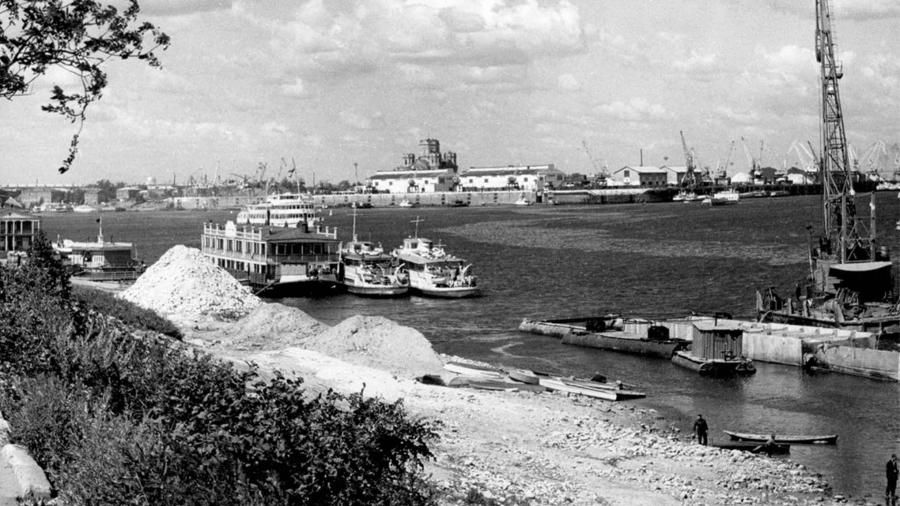
On 16 March 1930 an order was issued liquidating the fair as a phenomenon declared socially hostile
Nizhegorodskaya Pravda[6]
| Name | Years | Description |
|---|---|---|
| Kanavinsky Bridge | The first permanent bridge across the Oka, 1933 — it linked the fair side to the city | |
| Fair Packhouses on the Strelka) | Metal structures from the 1896 exhibition that became port warehouses | |
| Gorky River Port (rus-shipping.ru) | The cargo port on the Strelka — the main hub of Volga shipping | |
| Nizhny Novgorod Fair Water Intake Station | An engineering structure from the fair era that survived into the Soviet port | |
| Closure of the Nizhny Novgorod Fair in 1929 (nnov.ec) | The decision that ended a century of trading and turned the fair into warehouses | |
| Meschera Lake | A neighborhood that grew up on sand fill behind the fair | |
| Meshchersky Neighborhood | Late-Soviet housing development on the far side of the river |
Our own time: the stadium, the pakgauzy, the embankment
Returning the Strelka to the city took the last ten years. In 2015, while preparing for the World Cup, the exhibition trusses of the pakgauzy were rediscovered under their brick cladding, and in 2017 the cladding was removed, preserving the metal frame. On the site of the port berths rose the Nizhny Novgorod Stadium, seating 45,000 and finished in the white and blue tones of the Volga landscape: the first test match, Olimpiyets against Zenit-2, took place on 15 April 2018, and during the World Cup the arena hosted six matches, beginning with Sweden against South Korea on 18 June 2018. On 12 June 2018 the Strelka metro station opened, after 1,140 days of construction — the city's first two-span station with a central row of columns, without escalators, with multimedia panels depicting a footballer and the Alexander Nevsky Cathedral.
On 2 June 2022 a concert hall with a panoramic window onto the confluence of the rivers opened in one of the pakgauzy, built to a concept by Sergei Choban's bureau SPEECH; the first to play there was the musicAeterna orchestra under Teodor Currentzis, and an exhibition hall opened in the second pakgauz. The territory itself was opened to free public access in 2021 — the work was carried out under the "Sreda 800" program for Nizhny Novgorod's 800th anniversary, together with the redevelopment of the Oka embankment. [6][7][8][9][10][11]
| Name | Years | Description |
|---|---|---|
| Strelka) | The spit where the Oka and the Volga meet — a symbol of the city and the site of its new center | |
| Strelka | The geographic point where the rivers meet | |
| Nizhny Novgorod Stadium (fcnn.ru) | The 2018 World Cup arena, built on the Strelka | |
| Pakhouses on the Strelka (packhouses.strelkapark.ru) | The restored 1896 structures that became a concert hall and exhibition hall | |
| Strelka-City | A business-district project planned for the Strelka | |
| Strelka Metro Station | The 2018 station that linked the Strelka to the city | |
| Rozhdestvenskaya Side | A pedestrian tourist route along the merchant street | |
| Concept for the Rozhdestvenskaya Stora Development Project | A program to revive the Lower Posad | |
| Nizhnevolzhskaya Embankment | The embankment beneath the kremlin, connecting Rozhdestvenskaya to the Strelka |
Sources
- opentextnn.ru — Otkrytyi Tekst — Kucherova T. V., Rozhdestvenskaya Street (archive)
- yarmarka.ru — Nizhny Novgorod Fair, official website — History of the Nizhny Novgorod Fair (archive)
- opentextnn.ru — Otkrytyi Tekst — Brief Guide to the Fonds of the Central Archive of Nizhny Novgorod Region (archive)
- opentextnn.ru — Otkrytyi Tekst — What Memory Has Preserved... Memoirs of A. F. Selivanova (archive)
- opentextnn.ru — Otkrytyi Tekst — Davydov A. I., On the Question of Choosing the Site for the Second Orthodox Church at the Nizhny Novgorod Fair (archive)
- Nizhegorodskaya Pravda — How the Pakgauzy on the Strelka Were Revived and Became a Point of Attraction (archive)
- Nizhegorodskaya Pravda — A Concert Hall Has Opened in the Pakgauzy on the Strelka in Nizhny Novgorod (archive)
- Nizhegorodskaya Pravda — How the Nizhny Novgorod Stadium Will Surprise Championship Guests (archive)
- Nizhegorodskaya Pravda — The First Match at the "Nizhny Novgorod Stadium" Will Take Place in April (archive)
- Nizhegorodskaya Pravda — The "Strelka" Metro Station in Nizhny Novgorod Marks Its Anniversary (archive)
- Nizhegorodskaya Pravda — The Strelka Will Be Opened to Free Public Access in 2021 (archive)